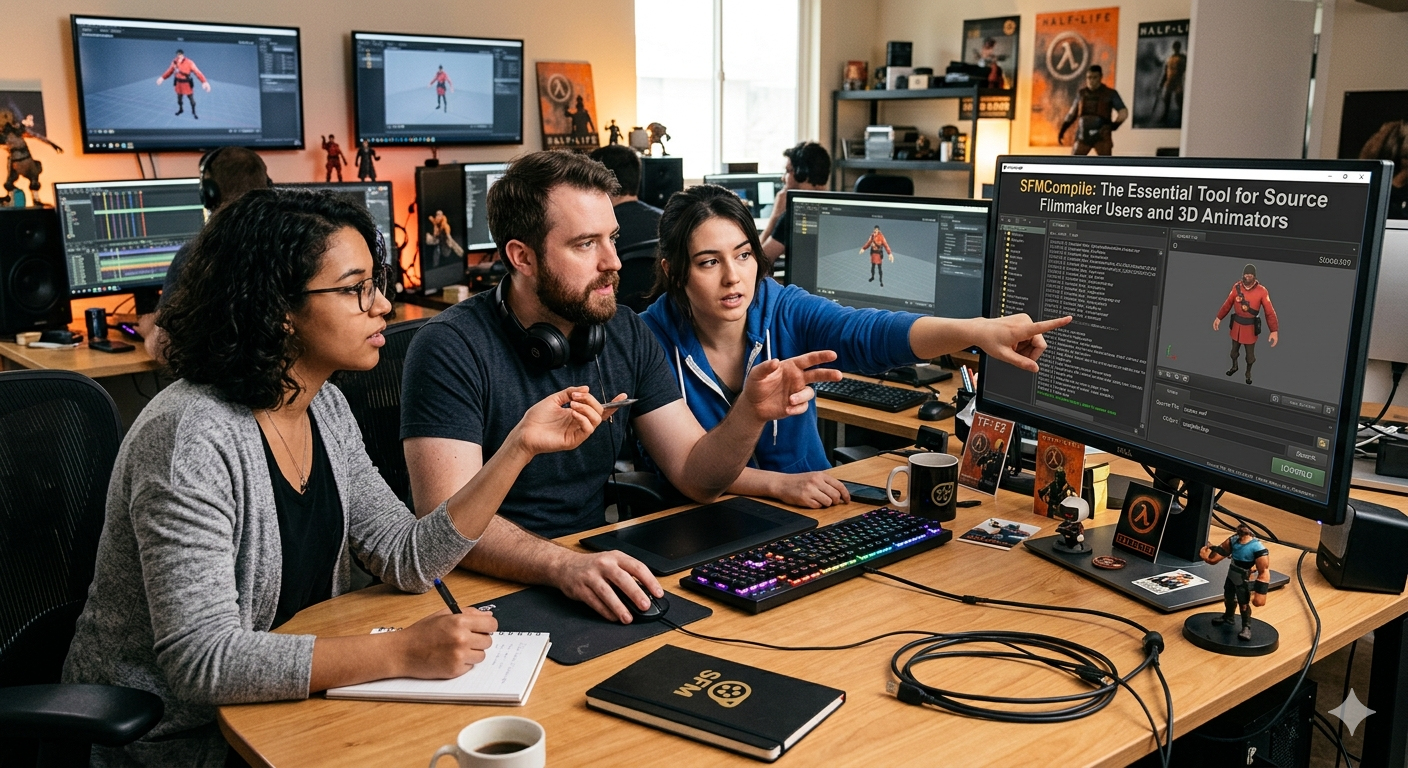
For anyone who has spent time in the world of 3D animation and video production using Valve’s Source Filmmaker, the word sfmcompile carries immediate recognition. It refers to the process and toolset used to compile custom assets into a format that Source Filmmaker can read, use, and incorporate into productions. Understanding sfmcompile is essential for any animator who wants to move beyond working with existing assets and start introducing custom models, textures, and animations into their work.
This article explains what sfmcompile is, how it works, who uses it, what problems it solves, and how to approach it as a beginner without losing your mind in the process.
Table of Contents
What Is Source Filmmaker?
Before diving into sfmcompile, a brief explanation of Source Filmmaker itself is useful. Source Filmmaker, commonly abbreviated as SFM, is a video and animation tool developed by Valve Corporation. It was built using Valve’s Source game engine and was originally used internally by Valve to produce cinematic content for games like Team Fortress 2 and Left 4 Dead.
Valve released Source Filmmaker to the public in 2012, and since then it has become an incredibly popular tool among fan animators, content creators, and independent filmmakers who work with game-based assets.
What Is SFMCompile?
SFMCompile is a compilation and conversion utility that processes raw asset files, typically in formats like OBJ, FBX, or other common 3D formats, and converts them into the compiled formats that the Source engine and Source Filmmaker require. These compiled formats include MDL files for models, VTF files for textures, and VMT files for materials.
Why SFMCompile Matters for Animators?
Expanding the Asset Library
One of the biggest creative limitations of working in Source Filmmaker is the finite library of officially supported assets. The built-in assets are extensive but they reflect the specific visual worlds of Valve’s own games. An animator who wants to create content set in a different universe, featuring original characters, or incorporating props and environments not found in those games has no choice but to bring in custom assets.
Community Content Creation
The Source Filmmaker community has built an enormous ecosystem of custom content, and sfmcompile is fundamental to how that content gets created and shared. Community-created model packs, texture packs, and asset libraries that populate platforms like the Steam Workshop almost universally went through some version of the sfmcompile process before becoming available to other animators.
The SFMCompile Process Explained
Step 1: Prepare Your Source Files
The process begins with the raw asset files created in 3D modeling software such as Blender, Maya, or 3ds Max. These need to be properly set up with correct geometry, appropriate UV mapping for textures, and clean topology before the compilation process begins. Errors in the source files will propagate into the compiled output.
Step 2: Configure QC Files
QC files are configuration scripts that tell the compiler how to process the model. They specify details such as the model’s name, its collision mesh, animation sequences, bone structure, level of detail settings, and surface properties. Writing a clean and accurate QC file is one of the more technically demanding parts of the sfmcompile process and one where many beginners encounter their first serious challenges.
Step 3: Run the Compiler
With source files and QC files ready, the sfmcompile process runs through the compiler, which interprets the QC instructions and converts the source geometry and texture files into the compiled formats the Source engine uses. Errors in this step produce error logs that point toward what needs to be fixed.
Step 4: Test in Source Filmmaker
Once compilation is complete, the assets are placed in the correct directory structure within Source Filmmaker’s file system and tested in the application. Testing reveals issues with scale, texture application, animation rigging, and other details that need to be resolved before the asset is production-ready.
For animators looking for comprehensive technical documentation on the Source engine’s asset pipeline and sfmcompile workflow, the Valve Developer Community wiki is the most authoritative reference available, containing detailed technical documentation maintained by Valve and experienced community contributors.
Common Problems and How to Solve Them
Model Appearing Incorrectly Scaled
Scale mismatches are among the most common issues in sfmcompile. Different 3D applications use different default unit scales, and Source Filmmaker expects models at a specific scale. Checking scale settings in both the source software and the QC file is the usual solution.
Textures Not Appearing Correctly
Texture problems in sfmcompile often stem from incorrect file paths in the VMT material file, unsupported texture dimensions, or textures that have not been properly compiled into the VTF format. Ensuring textures are power-of-two dimensions and correctly referenced in material files resolves most texture issues.
Animation Errors and Bone Problems
If a custom character model involves animations, bone naming conventions and hierarchy must match what the engine expects. Mismatched bone names or incorrect bone orientations will produce animation errors that are visible immediately when the model is loaded into Source Filmmaker.
Frequently Asked Questions About SFMCompile
Do I need programming knowledge to use sfmcompile
Not in the traditional sense. SFMCompile requires understanding of QC file syntax and the Source engine’s asset structure, but this is more configuration than programming. Many beginners with no coding background successfully learn sfmcompile through tutorials and community resources.
Is sfmcompile free to use
The core compilation tools associated with the Source engine, including studiomdl and VTFEdit, are available as free downloads. Various community-developed tools that streamline the sfmcompile workflow are also freely available.
Can I use sfmcompile for assets from other games
The sfmcompile process itself is engine-agnostic in that it converts files into Source format. However, using assets from other games raises copyright considerations. Assets should only be compiled and used with appropriate rights and permissions.
What 3D software works best with sfmcompile
Blender is the most popular choice among Source Filmmaker community members due to its free availability and the strong community-developed plugins that streamline the export process for sfmcompile. Maya is also widely used by more advanced creators.