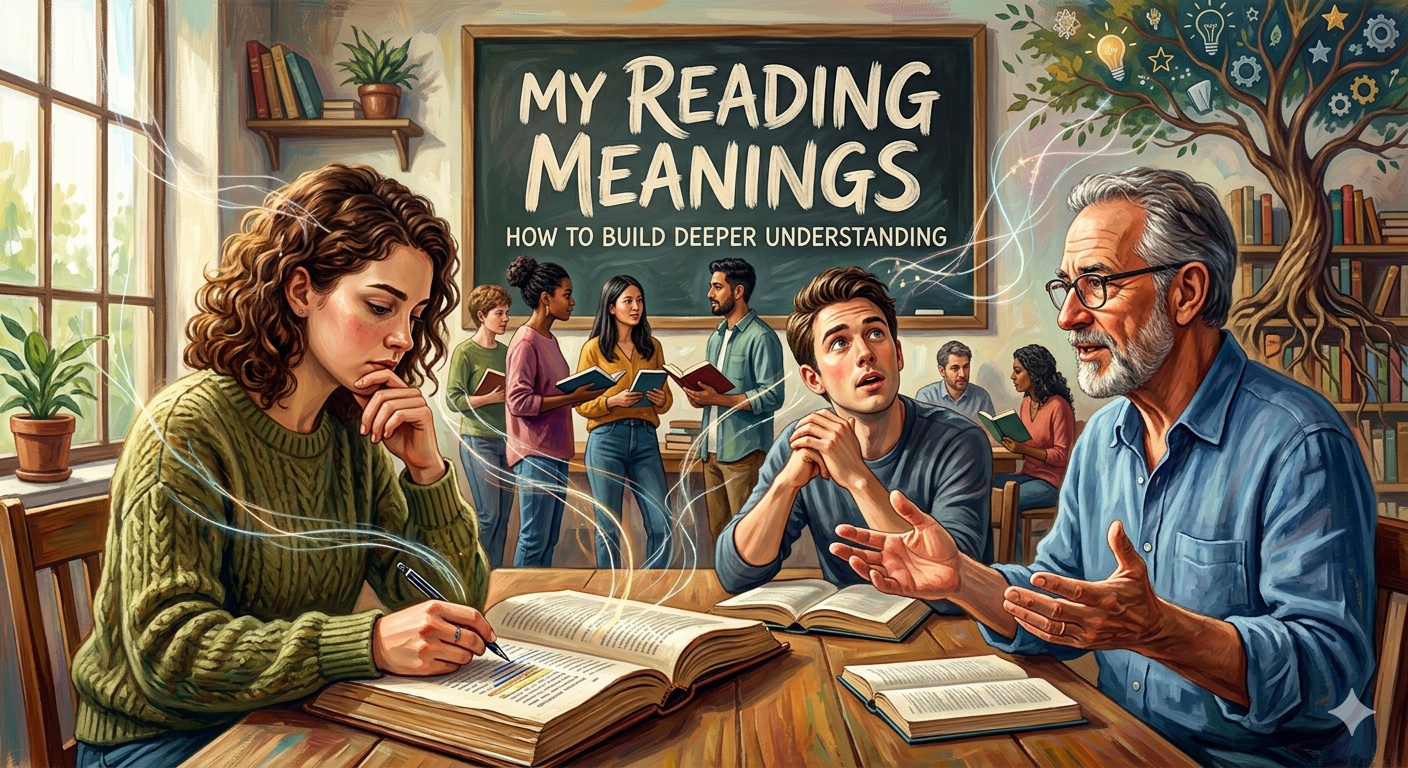
Reading is one of the most powerful tools available for personal growth, yet most people engage with it only partially. They read the words, absorb some information, and move on. The concept of myreadingmeanings points toward a different relationship with text, one that is more deliberate, more reflective, and far more rewarding.
Myreadingmeanings, as a practice and a framework, refers to the active pursuit of personal meaning-making through reading, the habit of engaging with texts not merely to extract information but to construct genuine understanding, to connect what you read to what you already know, and to allow books and articles to genuinely change how you think.
Table of Contents
What Is Myreadingmeanings?
Myreadingmeanings describes the practice of reading with an active focus on personal meaning construction rather than passive information consumption. It is grounded in the well-established educational understanding that reading comprehension is not simply decoding words on a page but a complex cognitive and interpretive process in which the reader actively constructs meaning by connecting text to prior knowledge, personal experience, and broader frameworks of understanding.
Why Active Meaning-Making Matters in Reading?
The Passive Reading Problem
Research in cognitive science and educational psychology consistently shows that passive reading, reading without active engagement, retention, or meaning-making, produces surprisingly poor outcomes in terms of actual learning. The feeling of having read something and the reality of having understood and integrated it are very different things, and the gap between them is larger than most readers assume.
The myreadingmeanings approach addresses this gap directly by building active engagement into the reading process itself, making meaning construction a deliberate practice rather than an accidental byproduct.
Reading as Thinking
The most productive relationship with reading is one in which reading is understood as a form of thinking rather than simply a form of receiving. When you read with the myreadingmeanings mindset, you are not simply absorbing an author’s thoughts. You are in conversation with them, testing their ideas against your own experience, questioning their assumptions, and building something new from the encounter.
Core Practices of Myreadingmeanings
Annotation and Marginalia
Writing in the margins or making digital notes alongside a text is one of the oldest and most effective practices associated with myreadingmeanings. When you annotate as you read, you are forced to articulate your responses to the text in real time. Questions, agreements, disagreements, connections to other things you have read, and moments of surprise or recognition all become part of a personal record of your encounter with the text.
The Question Practice
Before, during, and after reading, generating questions is a powerful myreadingmeanings practice. Before reading, ask what you already know about the topic and what you hope to understand better.
Connection Building
Myreadingmeanings is significantly enhanced by deliberately looking for connections between what you are reading and other things you know. These connections might be to other books, to personal experiences, to current events, or to questions you have been thinking about independently of the text.
Summary in Your Own Words
After finishing a section or a whole text, summarizing what you have read in your own words is a powerful test of whether genuine understanding has occurred. If you cannot explain the central ideas of what you have just read in your own language, the myreadingmeanings process has not yet completed its work.
For educators and learners seeking to deepen their understanding of evidence-based reading comprehension strategies that underpin the myreadingmeanings approach, Reading Rockets provides extensively researched resources on literacy development, reading comprehension strategies, and the science behind effective reading instruction.
Applying Myreadingmeanings to Different Types of Text
Non-Fiction and Information Texts
With non-fiction, myreadingmeanings involves actively evaluating the quality of evidence and argument, noting where claims are well-supported and where they are not, and connecting the information to your existing knowledge base.
Fiction and Literature
Myreadingmeanings applied to fiction involves attending to theme, character, language, and the ideas that the story explores beneath its surface narrative. Asking what a novel is really about, what questions it raises about human experience, and how the writing itself contributes to the meaning is the heart of literary myreadingmeanings practice.
Academic and Technical Reading
Technical reading with a myreadingmeanings approach means slowing down significantly, identifying the central claims or methods, understanding how evidence is used, and building a clear mental model of how the pieces fit together.
Building a Personal Reading Practice
- Set aside dedicated reading time that is protected from interruptions and distractions
- Keep a reading journal in which you record your responses, questions, and key insights from each book
- Read with a pencil or a digital annotation tool always accessible
- Discuss what you are reading with others, since conversation is one of the most powerful ways to test and deepen understanding
- Revisit your notes from previous books periodically to track how your thinking has developed over time
Frequently Asked Questions
Is myreadingmeanings suitable for all reading levels?
Yes. The core principles of active engagement, question generation, and meaning construction can be applied at every reading level. The specific strategies are adapted to suit the reader’s age and reading capacity, but the fundamental approach is universally applicable.
Does myreadingmeanings slow down reading?
It does slow reading down, particularly initially. But the improvement in comprehension, retention, and genuine understanding more than compensates for the additional time. Most people who adopt a myreadingmeanings approach find that they read fewer books but understand and retain far more from each one.
Can myreadingmeanings be applied to digital reading?
Yes, though digital reading presents challenges including higher rates of distraction and the greater ease of passive, skimming behavior online. Using digital annotation tools, reading in focused browser modes, and applying the same deliberate engagement practices to digital text as to print helps bridge this gap.
Is there a specific journal format for myreadingmeanings practice?
There is no single prescribed format. Some readers prefer simple lined notebooks with date and title entries. Others use structured templates with dedicated sections for summary, questions, key insights, and personal connections. The format that you will actually use consistently is always the best one.