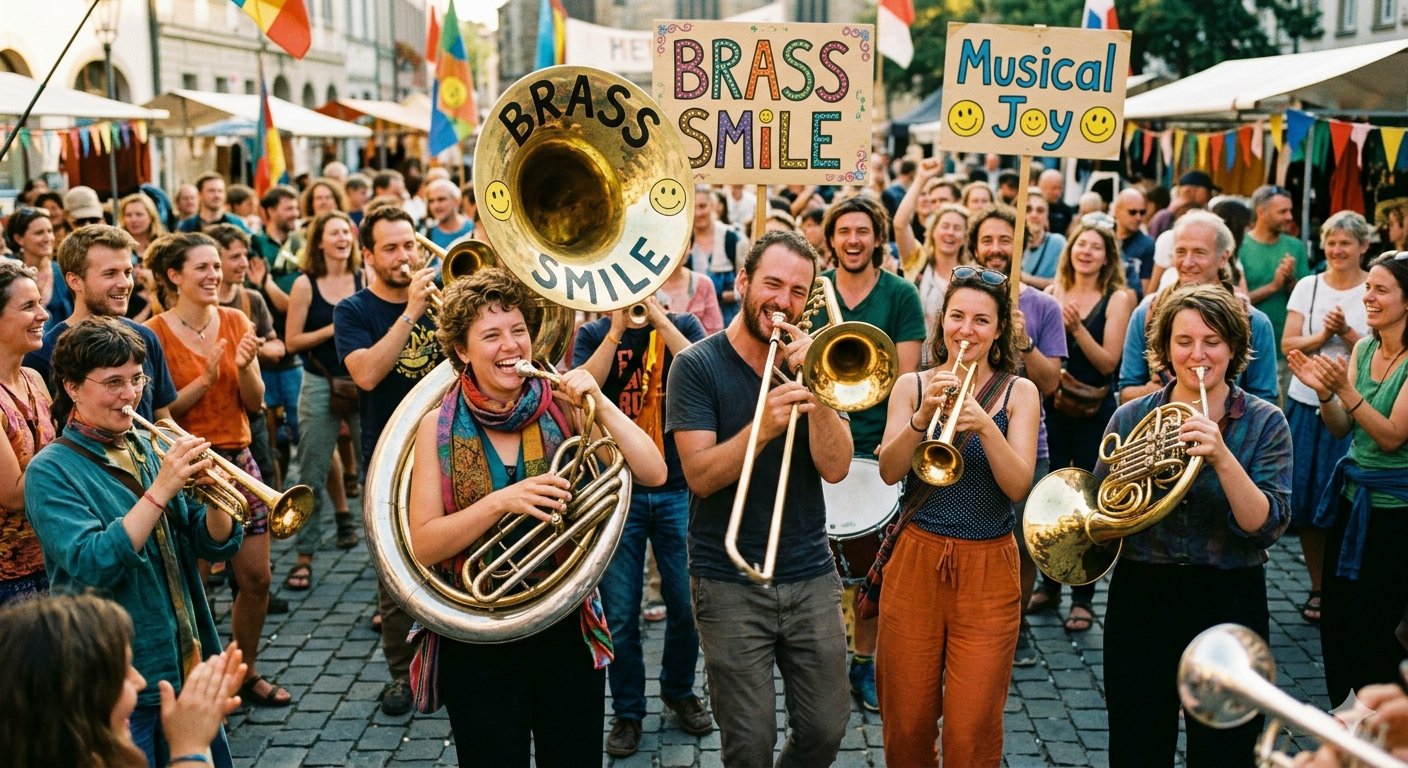
There is something fundamentally joyful about brass instruments. Whether it is the warm, resonant tone of a trombone filling a concert hall, the bright call of a trumpet cutting through the air at a parade, or the deep ceremonial presence of a tuba anchoring a marching band, brass instruments have a unique capacity to produce what might best be called a brasssmile: that involuntary, genuine expression of pleasure that good brass music provokes in listeners and players alike.
The concept of brasssmile captures something real about how people respond to well-played brass music. It is the smile that appears at a jazz club when the trumpet solo hits its emotional peak. It is the grin on the face of a tuba player who knows their instrument has just provided the harmonic foundation that made the whole ensemble click. It is the expression on a child’s face when they hear a brass band for the first time.
Table of Contents
What Are Brass Instruments?
Brass instruments are a family of wind instruments in which sound is produced by buzzing the lips into a cup-shaped mouthpiece, causing the column of air within the instrument to vibrate. The pitch is controlled by the player’s embouchure, the specific shaping and tension of the lips and facial muscles, combined with valves, slides, or holes that change the effective length of the air column and therefore the pitch.
The main members of the brass family include:
- Trumpet, the highest-pitched and most versatile of the standard brass instruments
- French horn, with its distinctive coiled shape and warm, mellow tone
- Trombone, the only standard brass instrument that uses a slide rather than valves for pitch changes
- Euphonium and baritone horn, medium-low brass instruments common in wind bands
- Tuba, the lowest-pitched member of the brass family and the harmonic foundation of any brass ensemble
- Flugelhorn, cornet, and bugle, which are related to the trumpet family with varying tonal characteristics
The Physics of That Brasssmile Sound
Why Brass Instruments Sound the Way They Do?
The distinctive timbre of brass instruments, the quality that makes a trumpet sound like a trumpet rather than a violin or a flute, comes from several interacting factors. The buzzing of the lips at the mouthpiece produces a rich complex of overtones.
The Emotional Impact of Brass Sound
The brasssmile effect is not purely psychological. Research in music psychology has found that the physical characteristics of brass instrument sound, including its carrying power, its rich overtone structure, and its capacity for both enormous dynamic range and intimate softness, trigger genuine emotional responses in listeners.
Brass Instruments Across Musical Traditions
Classical and Orchestral Music
In the classical orchestral tradition, brass instruments play roles ranging from the majestic to the intimate. Beethoven’s symphonies famously expanded the role of brass in the orchestra, and composers from Brahms to Mahler to Shostakovich have exploited the full dramatic and expressive range of the brass section.
Jazz and Improvisation
Jazz has arguably done more than any other tradition to demonstrate the expressive range of individual brass instruments. The trumpet in particular became the central solo voice of early jazz, and players from Louis Armstrong to Miles Davis to Dizzy Gillespie redefined what the instrument could say and how it could say it.
Brass Bands and Community Music
The brass band tradition, most strongly associated with Northern England and parts of Europe, represents one of the most democratic and community-rooted expressions of brass music making. Brass bands have historically been connected to working-class communities, industrial towns, and the tradition of amateur music-making as a form of social cohesion and collective expression.
For anyone interested in exploring the history and culture of brass music-making in more depth, the International Tuba Euphonium Association represents the global community of brass musicians and educators and provides extensive resources on brass instrument history, performance, and education.
Learning a Brass Instrument
Starting Out
Brass instruments are among the more demanding instruments to begin learning, primarily because of the physical demands of embouchure development. Building the specific muscle strength and control needed to produce a consistent tone takes weeks to months of regular practice. Many beginners are surprised by how much physical work is involved before the instrument begins to respond reliably.
The Long Game
The investment in learning a brass instrument pays compound returns over time. Once the physical fundamentals are established, brass instruments are remarkably expressive and versatile.
- Begin with proper instruction to establish correct embouchure from the start
- Practice for shorter periods more frequently rather than long infrequent sessions
- Join an ensemble as soon as basic competence allows, since playing with others accelerates learning
- Listen extensively to great brass playing across multiple genres to develop an internal sound ideal
- Be patient with the physical development process, knowing that the rewards are genuinely worth it
Frequently Asked Questions
Which brass instrument is easiest to learn first?
The trombone is often recommended as a good entry point because its slide mechanism gives visual and physical feedback about pitch that valved instruments do not provide. The trumpet is the most common starting choice and has the widest range of musical applications. The right instrument is ultimately the one that you are most drawn to.
At what age can children start learning a brass instrument?
Most brass teachers recommend starting no earlier than age seven or eight, when children have sufficient lung capacity and lip development for the physical demands of brass playing. Some instruments, like the French horn, are often started slightly later due to their technical demands.
How long does it take to get a good sound on a brass instrument?
Most beginners can produce a recognizable tone within their first few lessons. A genuinely musical, controlled, and expressive sound typically develops over one to three years of regular practice and quality instruction.
Are brass instruments expensive to maintain?
Brass instruments require regular cleaning, occasional valve or slide maintenance, and periodic professional servicing. The ongoing costs are generally modest compared to the investment in the instrument itself. Proper care significantly extends the playing life of a brass instrument.