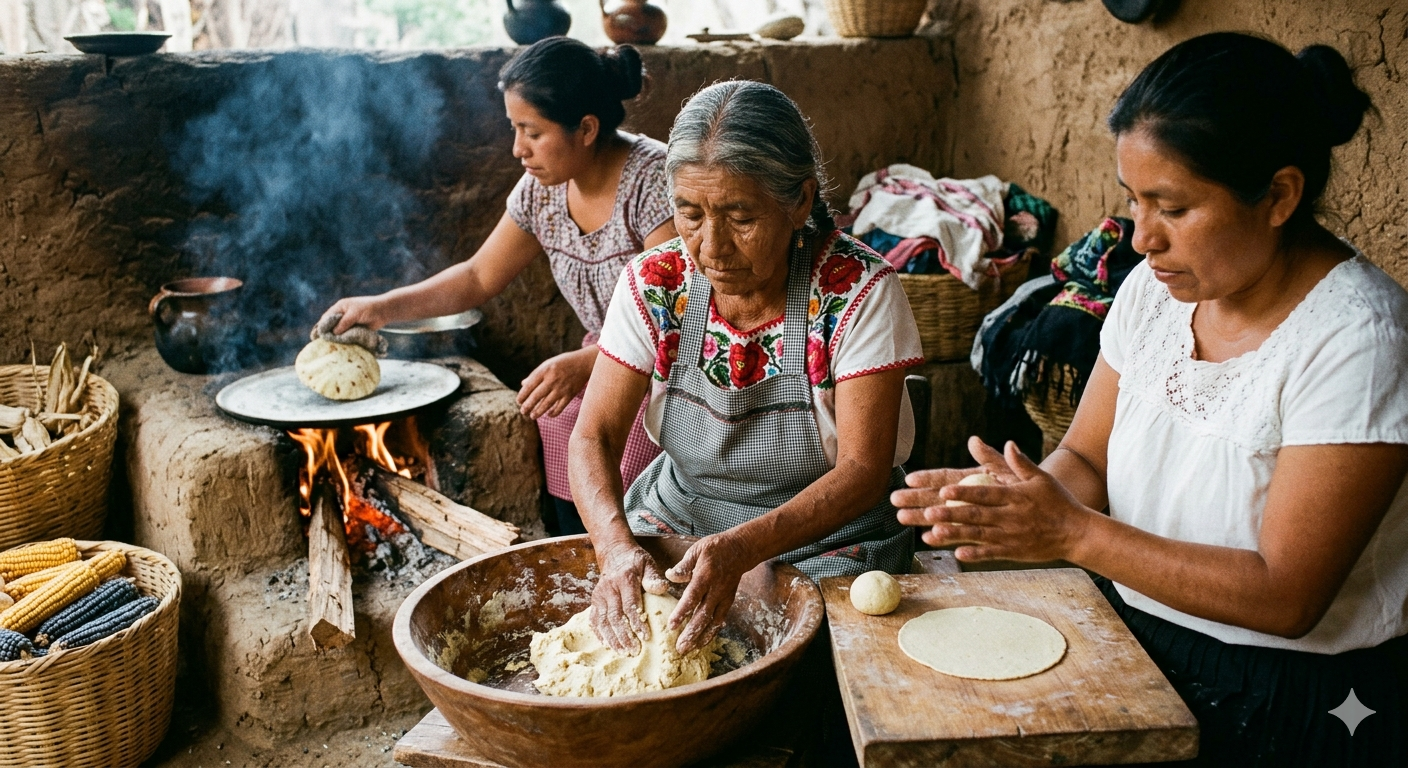
In Mexican regional vernacular, tortillando is the gerund form of tortillar — the act of making tortillas, expressed as an ongoing, never-finishing process. Unlike the English phrase “making tortillas,” the Spanish gerund implies something permanent, cyclical, embedded in daily life. You do not simply make tortillas once. You are always tortillando — as your grandmother was, as her grandmother was, as someone in your lineage has been for thousands of years.
This distinction matters enormously to the growing community of culinary anthropologists, indigenous food activists, and masa artisans who have claimed the word as a banner for their work. For them, tortillando is not a recipe or a technique — it is an identity, a practice, and a political act in the context of a global food system that has spent decades replacing indigenous knowledge with industrial convenience.
Table of Contents
The Science and Soul of Nixtamalization
At the foundation of every act of genuine tortillando lies a process called nixtamalization — an ancient Mesoamerican technique in which dried corn kernels are soaked and simmered in an alkaline solution, traditionally water mixed with cal (calcium hydroxide, or slaked lime). This transformation is both chemical and spiritual for practitioners who understand its full significance.
Industrial masa harina — the dried, reconstituted corn flour that most households and restaurants use today — shortcuts or entirely skips nixtamalization to achieve shelf stability and cost efficiency. The result is a product that approximates the texture of a tortilla but lacks its nutritional depth, aromatic complexity, and cultural integrity. According to Masienda’s detailed research on nixtamalization and heirloom corn, the difference between industrially processed masa and stone-ground nixtamalized masa from native corn varieties is not merely aesthetic — it is a fundamentally different food.
The Tactile Intelligence That Machines Cannot Replicate
One of the most important and least discussed dimensions of tortillando is the embodied knowledge it requires — what anthropologists sometimes call kinesthetic memory. An experienced tortillera, a woman who makes tortillas as her vocation, can assess the hydration of masa by the way it feels against her palm. She knows the comal’s readiness not by a thermometer but by the sound of water droplets on its surface and the faint change in the air above it.
Regional Variations That Define Place and Identity
Mexico’s tortilla tradition is defined by extraordinary regional diversity that reflects the ecological specificity of native corn varieties. In Oaxaca, the large, leathery tlayuda base is made from corn varieties adapted to the high valleys of the Sierra Juárez, producing a texture and flavor that cannot be replicated with corn grown elsewhere. In Sonora, wheat flour tortillas — introduced through Spanish colonial agriculture — are paper-thin and enormous, the product of a completely different agricultural history. In the Mixtec highlands, blue and red corn tortillas carry deep nuttiness and earthy mineral notes that white or yellow commercial varieties lack entirely.
Tortillando and the Seed Sovereignty Movement
The tortillando revival is inseparably linked to a broader struggle over seed sovereignty — the right of indigenous and farming communities to maintain ownership and control over the crop varieties they have developed over generations. The corn varieties most prized by serious tortillando practitioners are criollo or landrace maize: unpatented, non-GMO, deeply adapted to specific local ecologies, and held collectively by the communities that have cultivated them.
The Global Spread and the Appropriation Question
Tortillando has migrated globally. In Los Angeles, Chicago, and New York, tortillerias are cultural anchors for Mexican-American communities — spaces where the practice continues as living identity across generations. What is newer is the emergence of non-Mexican practitioners: chefs in London, Copenhagen, and Tokyo who have spent significant time in Oaxaca or Puebla and returned to open masa-focused restaurants, treating tortillando as a serious culinary discipline rather than ethnic cuisine to be simplified for foreign palates.
Starting Your Own Tortillando Practice
For those outside Mexico who want to approach the practice genuinely, the pathway involves more than buying a tortilla press. It begins with sourcing whole dried heirloom corn from importers who work directly with indigenous farmers, learning basic nixtamalization before touching a press, understanding how hydration ratios shift by variety and humidity, and mastering comal management — whether cast iron, carbon steel, or traditional clay barro.
Frequently Asked Questions About Tortillando
What is the difference between tortillando and simply making tortillas from a recipe?
Tortillando refers to the continuous, culturally embedded practice of masa-making as a living tradition — not a one-time recipe execution. It implies a relationship with the craft sustained over time, often connected to specific native corn varieties and regional techniques passed through generations rather than written instructions.
Can I start tortillando with store-bought masa harina?
Yes, as a starting point to learn the basic mechanics of pressing and cooking. However, for authentic tortillando, transitioning to whole corn nixtamalization using heirloom varieties is strongly recommended by practitioners. The difference in flavor, nutrition, and craft depth is substantial.
What comal material is most authentic for tortillando?
Traditional Oaxacan and Mixtec practice uses clay (barro) comales, which heat unevenly in a way experienced tortilleras compensate for through rotation technique. Cast iron is the most practical modern alternative. Carbon steel is also widely used and heats evenly across its surface.
Why does nixtamalization matter if tortillas taste fine without it?
Nixtamalization is not primarily about taste — it is about nutrition and bioavailability. Without it, the niacin in corn is inaccessible to human digestion, and the amino acid profile is incomplete. The process also develops the distinctive minerally aroma that defines authentic tortillas, so the flavor difference is real as well.
Where can someone outside Mexico learn tortillando from authentic practitioners?
Several avenues exist: immersive culinary programs in Oaxaca and Puebla, workshops offered by organizations like Comal Heritage Food Incubator in the United States, and direct apprenticeships facilitated by diaspora community organizations in cities with large Mexican-American populations including Los Angeles, Chicago, and Houston.