Across different parts of the world, communities organise themselves into local administrative and geographical units that carry deep cultural and historical significance. In Thailand, one such unit is the tumbon — a term that many outside Southeast Asia may be unfamiliar with but which plays a vital role in how Thai society is structured, governed, and experienced at the grassroots level.
Whether you are a traveller, a student of comparative governance, a researcher, or simply someone curious about how different societies manage local community life, understanding tumbons opens a window into a genuinely fascinating aspect of Thai culture and administration.
Table of Contents
What Is a Tumbon?
A tumbon (also spelled ‘tambon’ and derived from the Thai word for subdistrict) is a subdistrict administrative unit in Thailand. It sits within the broader local government hierarchy, positioned below the amphoe (district) level and above individual villages (mubaan). Think of it as roughly equivalent to a municipality, township, or parish in Western governmental structures — though with its own unique characteristics shaped by Thai legal tradition and cultural context.
Thailand’s administrative geography breaks down as follows: Changwat (Province) at the highest level, followed by Amphoe (District), then Tambon or Tumbon (Subdistrict), and finally Mubaan (Village) as the smallest unit. Each tumbon typically encompasses several villages and is managed by a Tambon Administrative Organisation (TAO), which holds responsibility for local infrastructure, public health services, education support, and community welfare.
The Historical Origins of Tumbons
Ancient Roots in Thai Governance
The concept of tumbons as administrative units is not a modern bureaucratic invention. Its origins trace back centuries to traditional Thai governance systems where local communities were managed through hierarchical structures tied closely to Buddhist temple networks, agricultural land distribution, and local noble patronage.
Formal codification of the tumbon system came during the reign of King Chulalongkorn (Rama V) in the late 19th century. As part of sweeping administrative reforms modelled partly on European systems of governance, Rama V reorganised the Thai kingdom into provinces, districts, and subdistricts. This restructuring gave tumbons their official status as units of local administration and laid the groundwork for the system that exists today.
20th Century Reforms
The modern framework for tumbon governance was significantly strengthened by the Tambon Council and Tambon Administrative Organisation Act of 1994, which devolved considerable powers to the TAO level. This was part of Thailand’s broader democratic decentralisation movement, giving local communities more authority over budgets, land use, and public services.
For authoritative background on Thailand’s local government structure, the World Bank’s governance resources on decentralization in Southeast Asia provide valuable comparative context across the region.
How Tumbons Are Governed Today
The Role of Tambon Administrative Organisations (TAOs)
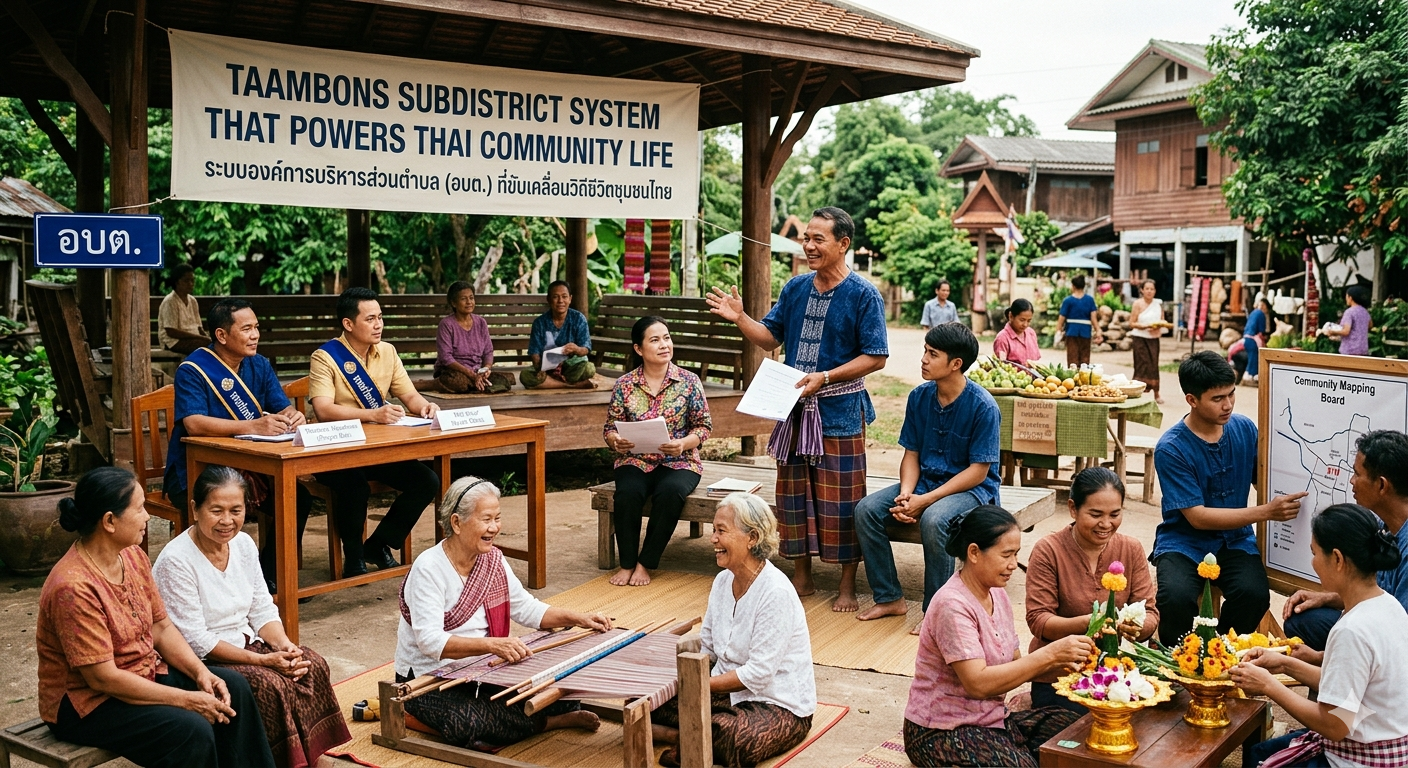
Every tumbon in Thailand with a sufficient population is administered by a TAO, which is an elected local council. Members of the TAO are chosen by residents through local elections held every four years. The council is headed by a Nayok TAO (TAO President), who acts as the chief executive officer of the subdistrict.
TAOs manage a range of responsibilities including road construction and maintenance, local water supply systems, waste management, community health promotion, supporting local schools and education centres, and preserving local cultural traditions and festivals. In more urbanised areas, some tumbons have been upgraded to municipality status (Tesaban), which comes with expanded powers and resources.
Population and Size
The size of individual tumbons varies considerably across Thailand. In rural provinces, a tumbon might cover a large geographical area with a scattered population. In peri-urban areas near major cities, tumbons can be densely populated and economically active. Thailand has over 7,000 tumbons spread across its 77 provinces, making them the backbone of grassroots governance across the country.
Cultural Significance of Tumbons
Beyond governance, tumbons hold genuine cultural weight in Thai life. Each subdistrict often has its own identity, shaped by local temple festivals, agricultural traditions, and community histories that stretch back generations. Residents typically feel a strong sense of belonging to their tumbon, a loyalty that sits alongside broader provincial and national identity.
Festivals and Community Life
Local wat (temple) festivals, which are anchored at the tumbon level, bring communities together multiple times a year. These events involve merit-making ceremonies, traditional performances, food markets, and sporting events. The TAO often plays an active role in organising and funding these festivals, reinforcing the connection between governance and cultural preservation.
Agriculture and Tumbon Identity
In Thailand’s predominantly agricultural regions, the tumbon’s identity is often tied to what it grows or produces. Rice cultivation, fruit orchards, rubber plantations, and fisheries define both the economy and the cultural character of individual tumbons. The TAO supports these industries through local infrastructure decisions and liaison with provincial and national agricultural agencies.
Tumbons and Tourism
For visitors to Thailand, tumbons often represent the authentic, unhurried side of the country that mass tourism rarely reaches. Staying in homestays organised at the tumbon level, participating in community-based tourism programmes, or simply exploring the villages within a single subdistrict can offer experiences that go far beyond the typical tourist trail. Many TAOs have actively developed community tourism initiatives, offering guided agricultural tours, traditional craft workshops, and cultural immersion programmes.
FAQs About Tumbons
Q: How many tumbons are there in Thailand? Thailand has over 7,000 tumbons (subdistricts) spread across its 77 provinces and special administrative areas.
Q: What is the difference between a tumbon and an amphoe? An amphoe is a district, which is a larger administrative unit. A tumbon is a subdistrict that sits below the amphoe level and contains multiple villages.
Q: Who runs a tumbon? Each tumbon is administered by a Tambon Administrative Organisation (TAO), led by an elected TAO President and a local council chosen by residents every four years.
Q: Is the tumbon system unique to Thailand? While other Southeast Asian countries have similar grassroots administrative tiers, the tumbon system with its specific TAO governance structure is unique to Thailand’s administrative framework.
Q: Can foreigners participate in tumbon activities? Yes. Many tumbons welcome foreign visitors through community-based tourism programmes. Cultural festivals, agricultural experiences, and homestays are often open to international guests.
Q: How does a tumbon become a municipality? When a tumbon’s population and urbanisation level reach certain thresholds set by national legislation, it can be upgraded to municipality (Tesaban) status, which comes with greater administrative powers and funding.
Tumbons are far more than bureaucratic lines on a map. They represent living communities with distinct identities, elected governance, cultural traditions, and economic activities that sustain millions of Thai families. Understanding the tumbon system offers a deeper appreciation for how Thailand balances central governance with genuine local autonomy.