Visual content has never been more central to how we communicate, market, and express creativity online. From social media posts and e-commerce product listings to print advertising and digital art, high-resolution, visually compelling imagery is the currency of the modern digital world.
Two technologies are fundamentally transforming how creators, marketers, photographers, and businesses work with images: AI image generators and AI-powered 4K image upscalers. Together, they represent a revolution in visual content creation — making professional-grade imagery accessible to anyone, regardless of budget or technical expertise.
This comprehensive guide explores both technologies in depth, covering how they work, what they can do, who benefits from them, and how to choose the right tools for your specific needs.
Table of Contents
What is an AI Image Generator?
An AI image generator is a software system that uses artificial intelligence — specifically deep learning models trained on vast datasets of images — to create original visual content from text descriptions, reference images, or combinations of both. Rather than requiring a photographer, illustrator, or graphic designer, these tools enable virtually anyone to produce high-quality imagery by simply describing what they want in plain language.
How AI Image Generators Work
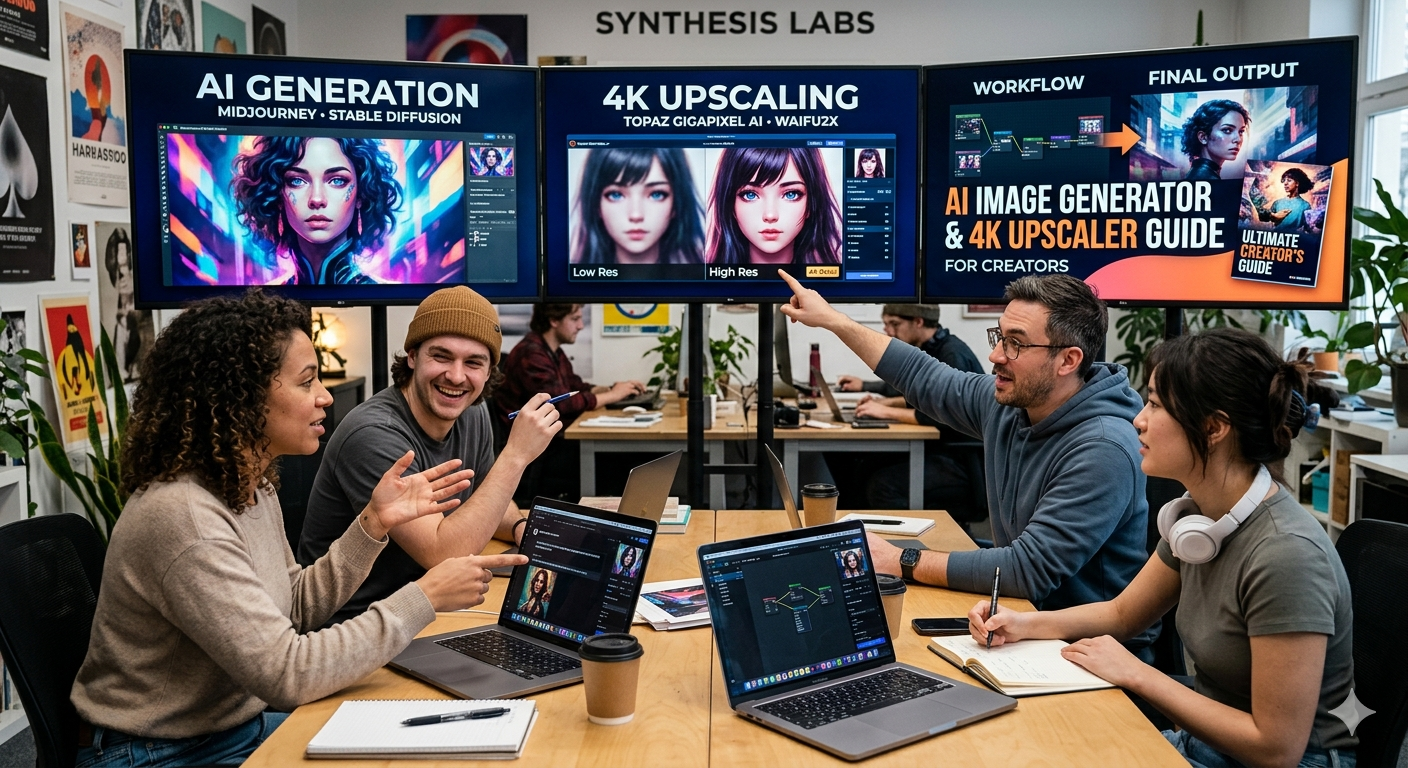
The underlying technology varies by platform, but most modern AI image generators use one of two primary approaches. Diffusion Models are used by tools like Midjourney, DALL-E, and Stable Diffusion, where the AI starts with random noise and progressively refines it into a coherent image guided by the text prompt. These models excel at producing diverse, high-quality, photorealistic, and artistic imagery.
Leading AI Image Generator Tools in 2026
The AI image generation landscape has matured significantly. Midjourney is renowned for its artistic quality and distinctive aesthetic, making it a favorite among designers, concept artists, and marketing professionals. DALL-E (by OpenAI) integrates across OpenAI’s ecosystem and excels at precise, instruction-following image generation, ideal for specific commercial applications.
What is an AI 4K Image Upscaler?
An AI image upscaler is a tool that uses artificial intelligence to increase the resolution of an image without sacrificing quality. Traditional image upscaling methods simply stretched existing pixels, resulting in blurry, pixelated, and often unusable enlargements. AI upscalers fundamentally change this by using deep learning to intelligently reconstruct missing details.
How AI Upscaling Works
AI image upscalers are trained on millions of pairs of high-resolution and low-resolution images. Through this training, the AI learns to recognize patterns, textures, edges, and structural elements that should be present at higher resolutions — even when they are absent in the source image.
When you upload a low-resolution image, the AI analyzes it at a pixel level, identifies these patterns, and generates new pixels that blend naturally with the original content.
Generative vs. Conservative Upscaling
Two distinct approaches to AI upscaling have emerged, each suited to different use cases. Generative Upscaling: Platforms like Magnific AI and LetsEnhance use generative models that “imagine” what missing pixels should look like — adding skin texture, fabric weaves, leaf veins, and other realistic details that were not present in the original. This approach produces stunning results for AI-generated art, portraits, and creative content, but may alter factual details.
Key Benefits of AI Image Generation and Upscaling
Cost and Time Efficiency
Traditional high-quality image production requires photographers, illustrators, or graphic designers — and often significant time and budget investment. AI image generators and upscalers dramatically reduce both. A marketer can produce dozens of on-brand product visualization images in hours, not days.
Accessibility and Democratization
These tools have dramatically lowered the barrier to professional-quality visual content. Anyone with an internet connection can now produce imagery that would previously have required specialized equipment, software expertise, and significant financial resources.
Scalability
AI tools handle volume in ways human creators simply cannot. E-commerce sellers managing thousands of product images, agencies handling large-scale advertising campaigns, and publishers requiring consistent visual content at scale can leverage AI to process and enhance images in batch, dramatically improving operational efficiency.
Restoration and Preservation
AI upscalers have become invaluable for restoring old, damaged, or low-resolution photographs. Family archives, historical records, and cultural heritage materials can be revitalized with remarkable fidelity, preserving memories and historical records in high-definition quality for future generations.
Practical Use Cases
E-Commerce and Product Photography
Online retailers benefit enormously from both technologies. AI image generators can create lifestyle product visualizations without costly photo shoots. AI upscalers ensure product images are sharp, detailed, and visually appealing at any display size — crucial for conversion rates in competitive online marketplaces.
Social Media and Content Marketing
Content creators and social media managers use AI image tools to maintain a consistent, high-quality visual presence across platforms. Whether generating custom illustrations for blog posts or upscaling older visuals for new campaigns, these tools support sustained creative output at manageable cost.
Print and Large-Format Advertising
Print materials — posters, banners, trade show displays — require high-resolution source images. AI upscaling bridges the gap, allowing digital assets optimized for screens to be enhanced to print-ready quality without expensive reshoots.
Game and Entertainment Design
Game developers, concept artists, and entertainment designers use AI image generators for rapid prototyping of characters, environments, and visual assets. The speed of AI generation accelerates creative iteration and pre-visualization.
Choosing the Right Tools
A comprehensive review of leading AI image upscalers, including LetsEnhance, Topaz Photo AI, and Magnific AI, is available through LetsEnhance’s AI upscaler comparison guide, which provides detailed analysis of features, output quality, and pricing across leading platforms.
When selecting an AI image generator or upscaler, consider the following factors: Use Case — creative or artistic work favors generative models; factual or commercial applications benefit from conservative approaches.
Frequently Asked Questions (FAQs)
Q1: What is the difference between an AI image generator and an AI upscaler?
An AI image generator creates entirely new images from text prompts or reference inputs. An AI upscaler takes an existing image and increases its resolution and detail without creating new content — it enhances what is already there.
Q2: Can AI upscalers really make a low-resolution image look like it was taken in 4K?
Yes, in many cases. Modern AI upscalers can produce remarkably convincing 4K outputs from low-resolution sources by intelligently reconstructing texture, edge, and detail information. Results vary by image type and tool, but the best tools deliver impressive quality improvements.
Q3: Are AI-generated images copyright-free?
Copyright status for AI-generated images is a complex and evolving area of law. In most jurisdictions, purely AI-generated content without significant human creative input may not be eligible for copyright protection.